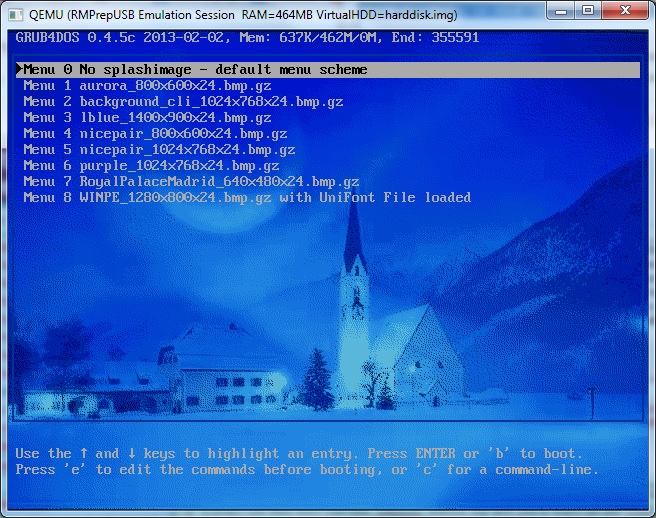
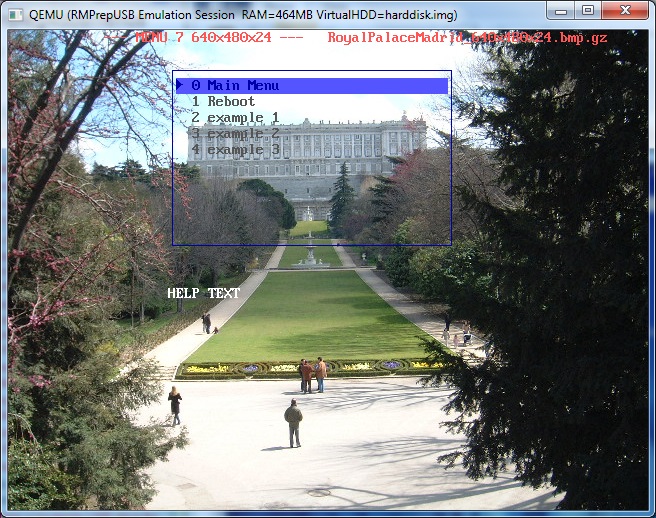
The menu code below cannot just be cut and pasted into one large menu.lst file! You need to just take the bits that you need! EXAMPLESThe grub4dos menus and code snippets below should be copied into your on=wn menu - DO NOT JUSt COPY THIS WHOLE PAGE! Please search this site for the relevant tutorials! #check version of grub4dos is later than 01-02-2012 checkrange 20120201:-1 read 0x8278 || pause --wait=3 Please use grub4dos-0.4.5c-2012-02-01 or later! && exit 1 #reset key map setkey #change key map for UK keyboard setkey setkey at doublequotesetkey doublequote at setkey tilde bar setkey numbersign backslash #French setkey setkey less backquote setkey greater tilde setkey ampersand 1 setkey 1 exclam setkey tilde 2 setkey 2 at setkey doublequote 3 setkey 3 numbersign setkey quote 4 setkey 4 dollar setkey parenleft 5 setkey 5 percent setkey minus 6 setkey 6 caret setkey backquote 7 setkey 7 ampersand setkey underscore 8 setkey 8 asterisk setkey backslash 9 setkey 9 parenleft setkey at 0 setkey 0 parenright setkey parenright minus setkey numbersign underscore :: no change for equal :: no change for plus setkey a q setkey A Q setkey z w setkey Z W setkey caret bracketleft :: no equivalent for diaresis => we keep the US braceleft setkey dollar bracketright :: no equivalent for pound => we keep the US braceright setkey q a setkey Q A setkey m semicolon setkey M colon setkey bracketleft quote setkey percent doublequote setkey asterisk backslash setkey bracketright bar setkey w z setkey W Z setkey comma m setkey question M setkey semicolon comma setkey period less setkey colon period setkey slash greater setkey exclam slash setkey bar question #Japan 106 setkey setkey at bracketleft setkey doublequote at setkey ampersand caret setkey quote ampersand setkey parenleft asterisk setkey parenright parenleft setkey underscore parenright setkey equal underscore setkey plus colon setkey colon quote setkey asterisk doublequote setkey bracketleft bracketright setkey braceleft braceright setkey bracketright backslash setkey braceright bar setkey backslash backquote setkey tilde plus setkey caret equal setkey backquote braceleft setkey bar tilde # to set a german keyboard use these setkey commands before the first title command setkey setkey yz setkey zy setkey YZ setkey ZY setkey equal parenright setkey parenright parenleft setkey parenleft asterisk setkey doublequote at setkey plus bracket right setkey minus slash setkey slash ampersand setkey ampersand percent setkey percent caret setkey underscore question setkey question underscore setkey semicolon less setkey less number sign setkey number sign backslash setkey colon greater setkey greater bar setkey asterisk braceright setkey setkey a q setkey A Q setkey z w setkey Z W setkey q a setkey Q A setkey m semicolon setkey M colon setkey w z setkey W Z setkey comma m setkey question M setkey semicolon comma setkey period less setkey colon period setkey slash greater setkey exclam slash setkey dollar bracketright setkey asterisk backslash setkey percent doublequote setkey ampersand 1 setkey 1 exclam setkey tilde 2 setkey 2 at setkey doublequote 3 setkey 3 numbersign setkey quote 4 setkey 4 dollar setkey parenleft 5 setkey 5 percent setkey minus 6 setkey 6 caret setkey backquote 7 setkey 7 ampersand setkey underscore 8 setkey 8 asterisk setkey caret 9 setkey 9 parenleft setkey at 0 setkey 0 parenright setkey parenright minus setkey less backquote setkey greater tilde setkey numbersign braceright setkey backslash question setkey bracketright braceleft setkey braceleft quote setkey braceright underscore #QWERTZ keyboard setkey setkey y z setkey z y setkey Y Z setkey Z Y setkey equal parenright setkey parenright parenleft setkey parenleft asterisk setkey doublequote at setkey backquote equal setkey plus bracketright setkey minus slash setkey slash ampersand setkey ampersand percent setkey percent caret setkey underscore question setkey question underscore setkey semicolon less setkey less numbersign setkey numbersign backslash setkey colon greater setkey greater bar setkey asterisk braceright setkey caret backquote setkey backslash minus # ensure not in debug=2 mode or gfxmenu will need two key presses! debug 1 gfxmenu /message color black/cyan yellow/cyan timeout 1 default 0 # line below will ensure the gfxmenu is always loaded even after an error configfile (bd)/menu.lst # if booting from a USB Flash drive get the UUID like this debug 1 uuid (bd) > (md)0x220+1 cat --skip=18 --length=9 (md)0x220+1 | set UUID= # if booting from HDD use --length=16 echo UUID of boot device is %UUID% # This works by mapping the boot device (bd) which may have bootmgr or ntldr on it, to a virtual memory drive so that files on it are not found by the find command title Boot to Windows from an internal hard disk map --mem (md)+8 (bd) map --hook find --set-root --ignore-floppies --ignore-cd /bootmgr || find --set-root --ignore-floppies --ignore-cd /ntldr map (bd) (bd) map --rehook chainloader /bootmgr || chainloader /ntldr #This entry sends an ESC character which can be used to exit from the GFXMenu back to the grub4dos text menu (or the user can just press ESC instead) #The file esc.txt must exist and contain the ESC character (0x1b or 27 or 033 octal) - the esc.txt file is in Beta Downloads section if you want it! title grub4dos menu cat /esc.txt && clear title List partitions clear cat (hd0,0)+1 > (md)800+1 && parttype (hd0,0) && echo Contents of (hd0,0): && ls (hd0,0)/ && echo && echo -------- cat (hd0,1)+1 > (md)800+1 && parttype (hd0,1) && echo Contents of (hd0,1): && ls (hd0,1)/ && echo && echo -------- cat (hd0,2)+1 > (md)800+1 && parttype (hd0,2) && echo Contents of (hd0,2): && ls (hd0,2)/ && echo && echo -------- cat (hd0,3)+1 > (md)800+1 && parttype (hd0,3) && echo Contents of (hd0,3): && ls (hd0,3)/ && echo && echo -------- cat (hd0,4)+1 > (md)800+1 && parttype (hd0,4) && echo Contents of (hd0,4): && ls (hd0,4)/ && echo && echo -------- cat (hd1,0)+1 > (md)800+1 && parttype (hd1,0) && echo Contents of (hd1,0): && ls (hd1,0)/ && echo && echo -------- cat (hd1,1)+1 > (md)800+1 && parttype (hd1,1) && echo Contents of (hd1,1): && ls (hd1,1)/ && echo && echo -------- cat (hd1,2)+1 > (md)800+1 && parttype (hd1,2) && echo Contents of (hd1,2): && ls (hd1,2)/ && echo && echo -------- cat (hd1,3)+1 > (md)800+1 && parttype (hd1,3) && echo Contents of (hd1,3): && ls (hd1,3)/ && echo && echo -------- cat (hd1,4)+1 > (md)800+1 && parttype (hd1,4) && echo Contents of (hd1,4): && ls (hd1,4)/ && echo && echo -------- echo pause --wait=10 Please check available partitions... configfile (bd)/menu.lst title Reboot reboot title Switch Off halt #hotkey and autonumber example color white/blue write 0x8274 0x2001 ## run hotkey once to enable hotkey. /hotkey## show this menu only if /ntldr can be found iftitle [find /ntldr] ^Ctrl+F1 Press Ctrl+F1 to boot /ntldr find --set-root /ntldr chainloader /ntldr # Check this CD/USB drive is not too old - see Tutorial #71 for details # Usage: /checkdate.g4b <Release Year> <Release Month> <Release DayOfMonth> <ExpiresInDays> [<SILENT>] /checkdate.g4b 2012 12 3 2 pause if NOT "%CHECKDATE%"=="OK" reboot #Boot using the original backup MBR sector (copied to LBA1 by grub4dos on install) #This will boot the system as it would before grub4dos was installed title Normal Windows Boot rootnoverify (hd0) chainloader (hd0)1+1 #this assumes you have booted from a USB drive and you want to boot from the hard disk title Boot from 1st Hard Disk \nBoot from MBR of first hard disk map (hd0) (hd1) map (hd1) (hd0) map --hook chainloader (hd0)+1 rootnoverify (hd0) title FreeDOS find --set-root /kernel.sys chainloader /kernel.sys title MSDOS find --set-root /io.sys chainloader /io.sys title FreeDOS (AS HDD) map (hd0) (hd1) map (hd1) (hd0) map --hook rootnoverify (hd1,0) chainloader /kernel.sys title FreeDOS (AS FLOPPY) map (hd0,0)+1 (fd0) map (hd0) (hd1) map (hd1) (hd0) map --hook chainloader (fd0)/kernel.sys rootnoverify (fd0) map --floppies=1 title MS-DOS (AS HDD) rootnoverify (hd0,0) chainloader (hd0,0)/io.sys title Always boot from USB to MS-DOS AS FLOPPY DISK A: checkrange 0x80 read 0x8280 && map (hd0,0)+1 (fd0) checkrange 0x80 read 0x8280 && map (hd1) (hd0) checkrange 0x80 read 0x8280 && map --hook ls (fd0)/io.sys && clear && pause --wait=1 /IO.SYS found on floppy disk ls (fd0)/io.sys || pause --wait=3 /IO.SYS not found on floppy disk ls (fd0)/io.sys && chainloader (fd0)/io.sys ls (fd0)/io.sys && rootnoverify (fd0) ls (fd0)/io.sys && map --floppies=1 ls (fd0)/io.sys && map --harddrives=1 clear boot title MS-DOS (AS FLOPPY) AND HDD as HDD0 map (hd0,0)+1 (fd0) # map the first partition of the hard disk as a floppy disk map (hd0) (hd32) # map the UFD as a virtual cd map (hd1) (hd0) # map the real hard disk as hard disk 0 map --hook # hook Int13 interrupts so all map changes take affect chainloader (fd0)/io.sys # load the io.sys code into memory from the floppy disk (now ufd is fd0) rootnoverify (fd0) # set the file root as the floppy disk map --floppies=1 map --harddrives=1 # Tweak BIOS device numbers so DOS sees 1 floppy and 1 hd title MS-DOS (AS FLOPPY) AND HDD as HDD0 (no comments) map (hd0,0)+1 (fd0) map (hd0) (hd32) map (hd1) (hd0) map --hook chainloader (fd0)/io.sys rootnoverify (fd0) map --floppies=1 map --harddrives=1 # http://www.partition-saving.com/ title savepart.iso # map the iso file as a virtual cd map /savepart.iso (0xff) # hook the int 13 interrupt so the BIOS sees it as a CD map --hook # set the root path to the new virtual CD root (0xff) # boot from the CD chainloader (0xff) title spartbdk.img # map the 1.44MB floppy image as fd0 map /spartbdk.img (fd0) map --hook root (fd0) # load the freedos kernel.sys as the boot file chainloader /kernel.sys # Use SHIFT to boot linux in safe mode title Run Linux\nPress SHIFT+ENTER for safe mode /bios int=0x16 eax=0x00000200 > (md)0x300+1 && cat --skip=12 --length=2 (md)0x300+1 | set /a n=0x > nul set /a n=%n% & 0x03 > nul && if %n%>=1 echo SHIFT PRESSED! #LShift=01,RShift=02,CTRL=04,ALT=08,SCROLL=10,NUM=20,CAPS=40,INS=80 #set /a n=%n% & 0x04 > nul && if %n%>=1 echo CTRL PRESSED! set sf= if %n%>=1 set sf=acpi=off irqpoll noapic noapm nodma nomce nolapic nosmp kernel /casper/vmlinuz file=/cdrom/preseed/ubuntu.seed boot=casper %sf% splash initrd /casper/initrd.img title WinPe v2 map /bootmgr (rd) chainloader (rd)+1 root () ;Note: make sure the 'cheat code' fromusb is present and also the bootfromiso path to the iso file on the USB drive starts with a forward slash / ;The ISO filename needs to be 8.3 and is case sensitive too! title PCLinuxOS LiveCD \n * Boot direct from ISO file map --unhook map --unmap=0:0xff find --set-root --ignore-floppies /pclos.iso map --heads=0 --sectors-per-track=0 /pclos.iso (0xff) map --hook root (0xff) kernel (0xff)/isolinux/vmlinuz fromusb bootfromiso=/pclos.iso livecd=livecd root=/dev/rd/3 acpi=on vga=788 keyb=en vmalloc=256M edd=off initrd (0xff)/isolinux/initrd.gz title BackTrack 4 Final LiveCD (extracted ISO contents to bt4 folder) find --set-root /bt4/boot/vmlinuz kernel /bt4/boot/vmlinuz BOOT=/bt4/casper boot=/bt4/casper nopersistent rw quiet vga=0x315 initrd /bt4/boot/initrd.gz title MEMTEST86+ find --set-root /mt410.iso map /mt410.iso (hd32) map --hook root (hd32) chainloader (hd32) title memtest.img (memtest.img obtained from ISO) find --set-root /memtest.img map /memtest.img (fd0) map --hook chainloader (fd0)+1 rootnoverify (fd0) map --floppies=1 title memtest86+ (bin file) find --set-root /memtest.bin kernel /memtest.bin # USB Boot -> Fat32 Formatted title Norton Ghost 15 (hd32) find --set-root /iso/Ghost15.iso map /iso/Ghost15.iso (hd32) map --hook root (hd32) chainloader /BOOTMGR title Ultimate Boot CD (UBCD) v5.0 final\nthis is the 14 May 2010 edition,its an all in one Free Bootable CD for IT Pros, the cd consolidate as many diagnostic tools as possible into one bootable CD. find --set-root /ubcd50.iso map /ubcd50.iso (hd32) map --hook root (hd32) chainloader (hd32) title Ultimate Boot CD (UBCD) v5.11 \nthis is the August 2011 edition,its an all in one Free Bootable CD for IT Pros, the cd consolidate as many diagnostic tools as possible into one bootable CD. find --set-root /ubcd511.iso map /ubcd511.iso (hd32) map --hook root (hd32) chainloader (hd32) # only about 2MB is saved by using 7zip to compress the iso to a .gz file title Hirens Boot CD 13.1 using firadisk \nBoot to Hirens Boot CD in RAM find --set-root --ignore-floppies --ignore-cd /HirensBCD.13.1.iso.gz map --mem /firadisk.gz (fd0) map --mem /HirensBCD.13.1.iso.gz (0xff) map --hook root (0xff) chainloader (0xff) #iPXE boot - see the iPXE Tutorial for details title ipxe map /ISO/ipxe.iso (0xff) || map --mem /ISO/ipxe.iso (0xff) map --hook root (0xff) chainloader (0xff) # ---- GPARTED --- title 1 GParted Live (0.8.1-3) find --set-root --ignore-floppies /live/vmlinuz kernel /live/vmlinuz boot=live config noswap noprompt ip=frommedia nosplash initrd /live/initrd.img title 2 GParted Live (0.8.1-3) ToRAM find --set-root --ignore-floppies /live/vmlinuz kernel /live/vmlinuz boot=live config noswap noprompt toram=filesystem.squashfs ip=frommedia nosplash initrd /live/initrd.img title 3 GParted Live (0.8.1-3) without framebuffer find --set-root --ignore-floppies /live/vmlinuz kernel /live/vmlinuz boot=live config noswap noprompt ip=frommedia nomodeset vga=normal nosplash initrd /live/initrd.img title 4 GParted Live (0.8.1-3) failsafe find --set-root --ignore-floppies /live/vmlinuz kernel /live/vmlinuz boot=live config noswap noprompt acpi=off irqpoll noapic noapm nodma nomce nolapic nosmp ip=frommedia nomodeset vga=normal nosplash initrd /live/initrd.img #Note: if using FAT filesystem, the findiso pathname is CaSeSeNsItIvE! title gparted 11.0 live from ISO find --set-root /gparted-live-0.11.0-10.iso map /gparted-live-0.11.0-10.iso (0xff) || map --mem /gparted-live-0.11.0-10.iso (0xff) map --hook root (0xff) kernel /live/vmlinuz boot=live config union=aufs noswap noprompt vga=788 ip=frommedia findiso= /gparted-live-0.11.0-10.iso toram=filesystem.squashfs initrd /live/initrd.img #Note: if using FAT filesystem, the findiso pathname is CaSeSeNsItIvE! # http://sourceforge.net/projects/gparted/files/latest/download title gparted 0.12.1-5 live from ISO find --set-root /gparted-live-0.12.1-5.iso map /gparted-live-0.12.1-5.iso (0xff) || map --mem /gparted-live-0.12.1-5.iso (0xff) map --hook root (0xff) kernel /live/vmlinuz boot=live config ip=frommedia findiso=/gparted-live-0.12.1-5.iso initrd /live/initrd.img # for failsafe add ... #noapic noapm nodma nomce nolapic nomodeset nosmp vga=normal # ----- # http://hdt-project.org/wiki/hdt-0.5.0#Downloads - examine the hardware PCIID's etc. in a system (v small and quick!) title HDT (Hardware Detection Tool\nhdt-project.org\nType MENU for a GUI menumap /hdt-0.5.0.iso (0xff) map --hook root (0xff) chainloader (0xff) #You must first copy the /slax folder from the ISO file and place it on your USB pen title slax 6.1.2 map /iso/slax-6.1.2.iso (0xff) || map --mem /iso/slax-6.1.2.iso (0xff) map --hook root (0xff) kernel /boot/vmlinuz from=/iso/slax-6.1.2.iso ramdisk_size=6666 root=/dev/ram0 rw initrd /boot/initrd.gz title Kasperksy AV 2010 Rescue.iso map /rescue/rescue.iso (0xff) || --mem /rescue/rescue.iso (0xff) map --hook root (0xff) chainloader (0xff) title BartPE (from \MININT) find --set-root /minint/SETUPLDR.BIN chainloader /minint/SETUPLDR.BIN title SeaTools ISO map /SeaToolsDOS223ALL.ISO (0xff) map --hook map (0xff)/seatools.ima (fd0) map --hook root (fd0) chainloader /kernel.sys # boot from the .iso file (160MB) or use 7Zip to compress it to a .gz file (68MB) title BartPE ISO using firadisk \nBoot to BartPE in RAM find --set-root --ignore-floppies --ignore-cd /Bartpe.iso map --mem /firadisk.gz (fd0) map --mem /Bartpe.iso (0xff) map --hook root (0xff) chainloader (0xff) title DSLinux ISO find --set-root /dsl4410.iso map /dsl4410.iso (hd32) map --hook root (hd32) chainloader (hd32) # boot knoppix from ISO file (no need to modify ISO with 6.7+) # works with iso in root or subfolder (thanks to cdob from reboot.pro for workaround for subfolder!) # ISO boot discussion at http://reboot.pro/16252/ # iso path and filename are Case Sensitive!!! # Knoppix cheat codes listed at http://www.pendrivelinux.com/knoppix-cheatcodes/ # Set a unique variable (e.g. K1109) in each iftitle line iftitle [if exist /_ISO/ ADRIANE-KNOPPIX_V6.7.1CD-2011-09-14-EN.iso set K1109=/_ISO/ ADRIANE-KNOPPIX_V6.7.1CD-2011-09-14-EN.iso ] Boot %K1109% set ISO=%K1109% ls %ISO% > nul || find --set-root --devices=hf %ISO% map %ISO% (0xff) || echo %ISO% not contiguous - so need to load it all into memory... && map --mem %ISO% (0xff) map --hook root (0xff) kernel /boot/isolinux/linux bootfrom=/./%ISO% noeject noprompt ramdisk_size=100000 lang=en vt.default_utf8=0 apm=power-off nomce libata.force=noncq hpsa.hpsa_allow_any=1 loglevel=1 tz=localtime initrd /boot/isolinux/minirt.gz iftitle [if exist /KNOPPIX_V7.0.4CD-2012-08-20-EN.iso] Boot KNOPPIX set ISO=/KNOPPIX_V7.0.4CD-2012-08-20-EN.iso ls %ISO% > nul || find --set-root --devices=hf %ISO% map %ISO% (0xff) || echo %ISO% not contiguous - so need to load it all into memory... && map --mem %ISO% (0xff) map --hook root (0xff) kernel /boot/isolinux/linux bootfrom=/./%ISO% noeject noprompt ramdisk_size=100000 lang=en vt.default_utf8=0 apm=power-off nomce libata.force=noncq hpsa.hpsa_allow_any=1 loglevel=1 tz=localtime initrd /boot/isolinux/minirt.gz title KNOPPIX\nAt boot prompt type - knoppix bootfrom=/dev/hda0/KNOPPIX155.iso map /KNOPPIX511.iso (hd32) || map --mem /KNOPPIX511.iso (hd32) map --hook root (hd32) chainloader (hd32) title Knoppix 7 #http://www.knopper.net/knoppix-info/index-en.html set lang=en set ISOfile=/images/KNOPPIX_V7.0.5.iso cat --length=0 %ISOfile% > nul || find --set-root --devices=hf %ISOfile% map %ISOfile% (0xff) map --hook root (0xff) kernel /boot/isolinux/linux bootfrom=/dev/*%ISOfile% noeject noprompt ramdisk_size=100000 lang=%lang% vt.default_utf8=0 apm=power-off nomce libata.force=noncq hpsa.hpsa_allow_any=1 loglevel=1 tz=localtime initrd /boot/isolinux/minirt.gz title KNOPPIX 6.2.1\nNote: Must use modified initrd.gz to boot from ISO - Note: version specific - does not work with 6.7.0! #http://knol.google.com/k/yoshihide-nomura/how-to-boot-knoppix-directly-from-iso/2vzr3sm0dzndc/1# #http://www.knoppix.net/wiki/Cheat_Codes #http://archive.yoshimov.com/knoppix/initrd-mod-6.2.1.gz has modified initrd file #iso file and modifed initrd placed in ISO folder in this example find --set-root /iso/KNOPPIX_V6.2.1CD-2010-01-31-EN.iso map /iso/KNOPPIX_V6.2.1CD-2010-01-31-EN.iso (hd32) || map --mem /iso/KNOPPIX_V6.2.1CD-2010-01-31-EN.iso (hd32) map --hook root (hd32) echo "Loading kernel.." kernel /boot/isolinux/linux ramdisk_size=100000 lang=en vt.default_utf8=0 apm=power-off vga=791 nomce noeject noprompt quiet loglevel=0 tz=localtime fromiso=iso/KNOPPIX_V6.2.1CD-2010-01-31-EN.iso edd=off --echo "Loading modified initrd downloaded from http://archive.yoshimov.com/knoppix/initrd-mod-6.2.1.gz" initrd (bd)/iso/initrd-mod-6.2.1.gz || initrd (hd0,0)/iso/initrd-6.2.1.gz # Only the ISO file is required for this menu - 4th ptn on USb drive must be empty! iftitle [if exist (bd)/_ISO/Linux/precise-5.4.3.iso] Puppy Precise 5.4.3\nPuppy with persistence partnew (hd0,3) 0x00 (bd)/_ISO/Linux/precise-5.4.3.iso map (bd)/_ISO/Linux/precise-5.4.3.iso (0xff) map --hook root (0xff) kernel /vmlinuz pmedia=usbflash psavemark=1 fix=fsck initrd /initrd.gz # if get puppy_precise_5.4.3 not found. Dropping out to initial-ramdisk console error - check name and case of the .sfs file! # Extract files to /precise (only vmlinuz, initrd.gz and sfs needed) # rename PUPPY_PR.SFS to lower case puppy_precise_5.4.3.sfs title Puppy Precise kernel /precise/vmlinuz pmedia=usbflash psubdir=precise fix=fsck psavemark=1 initrd /precise/initrd.gz # Extract sfs to /precise # rename PUPPY_PR.SFS to lower case puppy_precise_5.4.3.sfs and place in \precise folder title Puppy Precise boot from ISO map /_ISO/Linux/precise-5.4.3.iso (0xff) map --hook root (0xff) kernel /vmlinuz pmedia=usbflash psavemark=1 fix=fsck psubdir=precise initrd /initrd.gz # -- CLONEZILLA --- title CLONEZILLA (wait 2-3 minutes and hit Enter twice!) ;long wait at splash screen but it works! kernel /live/vmlinuz1 locale=us boot=live persistent initrd /live/initrd1.img ;long wait at splash screen but it works! map (hd0) (hd1) map (hd1) (hd0) kernel /live/vmlinuz1 locale=us boot=live persistent initrd /live/initrd1.img title Parted Magic /ISO/pmagic_2013_02_28.iso (booting the kernel) map /ISO/pmagic_2013_02_28.iso (0xff) map --hook root (0xff) kernel /pmagic/bzImage edd=off load_ramdisk=1 prompt_ramdisk=0 rw vga=normal sleep=10 loglevel=0 max_loop=256 vmalloc=384MiB keymap=us iso_filename=/ISO/pmagic_2013_02_28.iso initrd /pmagic/initrd.img title pmagic_2012_06_07.iso #name must be in pmagic-yyyy_mm_dd.iso format and in root folder or will not find the .sqfs file find --set-root /pmagic_2012_06_07.iso map --heads=0 --sectors-per-track=0 /pmagic_2012_06_07.iso (0xff) map --hook root (0xff) chainloader (0xff) find --set-root /pmagic.iso map /pmagic.iso (hd32) map --hook root (hd32) kernel /pmagic/bzImage noapic load_ramdisk=1 prompt_ramdisk=0 rw vga=791 sleep=10 loglevel=0 keymap=uk iso_filename=/pmagic.iso initrd /pmagic/initramfs map --unmap=0:0xff title Parted Magic 5.2 (direct memory mapping and booting the kernel) find --set-root /pm52.iso map --mem /pm52.iso (hd32) map --hook root (hd32) kernel /pmagic/bzImage noapic load_ramdisk=1 prompt_ramdisk=0 rw vga=791 sleep=10 loglevel=0 keymap=us iso_filename=/pm52.iso initrd /pmagic/initramfs map --unmap=0:0xff find --set-root /acronis.iso map /acronis.iso (hd32) map --hook root (hd32) chainloader (hd32) title Acronis Recovery 2013 kernel /Recovery\ Manager/kernel.dat quiet media_for_linux vga=ask initrd /Recovery\ Manager/ramdisk.dat title Windows Password reset find --set-root /cd100627.iso map /cd100627.iso (0xff) map --hook chainloader (0xff) title OphCrack Password Cracker XP 2.3.1 find --set-root /ophcrack_xp/boot/bzImage kernel /ophcrack_xp/boot/bzImage rw root=/dev/null vga=normal ophcrack=lowram lang=C kmap=uk screen=1024x768x16 autologin initrd /ophcrack_xp/boot/rootfs.gz title OphCrack Password Cracker Vista 2.3.1 find --set-root /ophcrack_vista/boot/bzImage kernel /ophcrack_vista/boot/bzImage rw root=/dev/null vga=normal ophcrack=lowram lang=C kmap=uk screen=1024x768x16 autologin initrd /ophcrack_vista/boot/rootfs.gz title PC CMOS Cleaner and Parted Magic 5.7 ISO find --set-root /pmagic-5.7.iso map --heads=0 --sectors-per-track=0 /pmagic-5.7.iso (hd32) map --hook root (hd32) chainloader (hd32) title Slitaz 4 RC1 Live find --set-root /slitaz-4.0-RC1.iso map --heads=0 --sectors-per-track=0 /slitaz-4.0-RC1.iso (0xff) map --hook root (0xff) chainloader /boot/isolinux/isolinux.bin title SliTaz Cooking (may be no kbd in GUI?) find --set-root /slitaz-cooking.iso map --heads=0 --sectors-per-track=0 /slitaz-cooking.iso (0xff) map --hook root (0xff) kernel /boot/bzImage rw root=/dev/null #vga=normal lang=C kmap=uk screen=1024x768x16 autologin initrd /boot/rootfs.gz title SliTaz 3.0 find --set-root /slitaz-3.0.iso map --heads=0 --sectors-per-track=0 /slitaz-3.0.iso (0xff) map --hook root (0xff) kernel /boot/bzImage rw root=/dev/null #vga=normal lang=C kmap=uk screen=1024x768x16 autologin initrd /boot/rootfs.gz # - - - - - - - - - # # GENERIC ANY LINUX BOOT FROM ISO TECHNIQUE! # See Tutorial 93 for details # This menu can be used for to boot any linux iso file # It is especially useful if your boot drive is NTFS but linux does not understand NTFS once it boots and so cannot boot further # WARNING: permanently alters the boot device's partition table (adds a 4th ptn entry)! # Use with care as it will obliterate ptn 4 on the boot device if it already exists! # see http://reboot.pro/topic/9916-grub4dos-isohybrided/page-2#entry88531 for details iftitle [if exist /tails-i386-0.15.iso] Tails (boot from ISO) set ISO=tails-i386-0.15.iso find --set-root %ISO% parttype (hd0,3) | set check= set check=%check:~-5,4% if %check%==0x00 partnew (hd0,3) 0x00 %ISO% if NOT %check%==0x00 echo ERROR: Partion Table entry 4 already exists! && pause --wait=3 && configfile /menu.lst map /%ISO% (0xff) echo -e \r\n map --hook root (0xff) chainloader (0xff) #some examples not using iftitle so they will always be listed even if the ISO file does not exist! title raring-dvd-i386.iso\nEdubuntu 13.04 Alpha 1 Test Build set ISO=/raring-dvd-i386.iso find --set-root %ISO% parttype (hd0,3) | set check= set check=%check:~-5,4% if %check%==0x00 partnew (hd0,3) 0x00 %ISO% if NOT %check%==0x00 echo ERROR: Partion Table entry 4 already exists! && pause --wait=3 && configfile /menu.lst map %ISO% (0xff) map --hook root (0xff) chainloader (0xff) title systemrescuecd-x86-3.1.2.iso\nSystemRescueCD set ISO=/systemrescuecd-x86-3.1.2.iso find --set-root %ISO% parttype (hd0,3) | set check= set check=%check:~-5,4% if %check%==0x00 partnew (hd0,3) 0x00 %ISO% if NOT %check%==0x00 echo ERROR: Partion Table entry 4 already exists! && pause --wait=3 && configfile /menu.lst map %ISO% (0xff) map --hook root (0xff) chainloader (0xff) # - - - - - - - - END OF GENERIC ISO EXAMPLES - - - - - # #load a gzipped floppy disk image (convert to .gz using gzip or 7Zip) title MSDOS 6.22 using chainloader from gz file find --set-root /dos622.ima.gz map --mem /dos622.ima.gz (fd0) map --hook rootnoverify (fd0) chainloader (fd0)+1 find --set-root /RCDx86_298.iso map /RCDx86_298.iso (hd32) map --hook root (hd32) chainloader (hd32) # ActiveBootDisk (pe 3.1 based) # extract the two files _bootDisk.ini and BOOTDISK.KEY from ISO and place in the root of the drive first! title Active@ Boot Disk 6.5 map /ISO/ActiveBootDisk.ISO (0xff) || map --mem /ISO/ActiveBootDisk.ISO (0xff) map --hook root (0xff) chainloader (0xff) || chainloader (0xff)/BOOTMGR #MEMDISK is not really needed as the built in grub4dos CHAINLOADER command is similar in action and allows for direct drive remapping, However, it is useful in being able to load .zip files which chainloader cannot (chainloader can load .gz compressed files however). #MEMDISK allows booting legacy operating systems. MEMDISK can boot floppy images, hard disk images and some ISO images see here for details. #MEMDISK simulates a disk by claiming a chunk of high memory for the disk and a (very small - 2K typical) chunk of low (DOS) memory for the driver itself, then hooking the INT 13h (disk driver) and INT 15h (memory query) BIOS interrupts. The memdisk binary can be obtained from the syslinux project here . #initrd loads the specified file into the ramdrive (initialise ramdrive) title Memtest 86+ title MEMTEST86+ iso using memdisk kernel /memdisk iso initrd /mt410.iso #use raw mode (raw access to protected mode) title MSDOS floppy disk image kernel /memdisk raw initrd /dos622.ima title MSDOS 6.22 using memdisk raw from zip file of floppy disk image (1.44MB image compressed as .zip file) kernel /memdisk raw initrd /dos622.zip title MSDOS 6.22 using memdisk raw from .gz file of floppy disk image (1.44MB image compressed as .gz file) kernel /memdisk raw initrd /dos622.ima.gz # http://www.mepis.org/ # Mount the SimplyMEPIS-1.5G_11.0.12_32.iso file # Copy the mepis folder to your USB drive # Copy the boot folder to the inside of the mepis folder # USB Drive folders: # /mepis has large mepis file # /mepis/boot has initrd.gz and vmlinuz # Use either "root" for user and "root" for password, or "demo" for user and "demo" for password.title SimpleMEPIS Default kernel /mepis/boot/vmlinuz vga=788 quiet splash initrd /mepis/boot/initrd.gz title SimpleMEPIS AUFS_rw_filesystem\nNothing is stored on the flash drive, all changes are temporary kernel /mepis/boot/vmlinuz vga=788 quiet splash aufs initrd /mepis/boot/initrd.gz # Look for specific BIOS or System type #0x680 = D000:0 - the start of the DMI and BIOS area #0x180 = 30000h - the length of the search, so it will finish at F000:FFFFh - i.e. end of BIOS area #So if the DMI string was 'EeePC' on one system and 'DELL' on another, then use set SYSTEM= if "%SYSTEM%"=="" cat --locate=\x45\x65\x65\x50\x43 (md)0x680+0x180 > nul && set SYSTEM=EeePC if "%SYSTEM%"=="" cat --locate=\x44\x45\x4C (md)0x680+0x180 > nul && set SYSTEM=DELL <more here> if "%SYSTEM%"=="" pause --wait=3 ERROR: No BIOS strings found that I recognise! && configfile /menu.lst echo "%SYSTEM%" found: # Next line displays the hex string and following bytes for user interest! cat --hex --length=0x80 --skip=%?% (md)0x680+0x180 if "%SYSTEM%"=="DELL" set MYISO=/dell.iso if "%SYSTEM%"=="EeePC" set MYISO=/EeePC.iso <more here> # now do stuff with the correct ISO! # check mainboard MAC address - e.g. MAC address is 00:23:54:58:32:6b cat --locate=\x00\x23\x54\x58\x32\x6b (md)0x680+0x180 || pause --wait=3 WRONG SYSTEM! && halt # Lock a menu entry to a MAC address (so that this will only work on one system which has MAC address = 00:23:54:58:32:6b!) # Use SCANBIOH.exe DOS tool from Beta Downloads page to find the correct memory location that contains your MAC address # You can also use this technique to match against your mainboard serial number or model type # See http://reboot.pro/14640/page__view__findpost__p__130251 for details. title Run MSSS only on my EeePC! #prevent checkrange from printing contents on the screen so it looks neater! debug off #check for the MAC address in BIOS RAM area checkrange 0x58542300 read 0xf0757 && checkrange 0x6b32 calc *0xf075b & 0xffff && echo OK - MAC ADDRESS 00:23:54:58:32:6b FOUND #if not correct MAC address then reload menu checkrange 0x58542300 read 0xf0757 || pause --wait=3 INCORRECT MAC ADDRESS! && exit checkrange 0x6b32 calc *0xf075b & 0xffff || pause --wait=3 INCORRECT MAC ADDRESS! && exit #now do any commands as normal find --set-root /MSSS_Media32.iso map /MSSS_Media32.iso (0xff) || map /MSSS_Media32.iso (0xff) map --hook chainloader (0xff) #Note: if you want to check a byte at any memory location use: checkrange 0x32 calc *0xf075b & 0xff || pause --wait=3 INCORRECT MAC ADDRESS! && exit #Note: if you want to check a word at any memory location use: checkrange 0x6b32 calc *0xf075b & 0xffff || pause --wait=3 INCORRECT MAC ADDRESS! && exit #Note: if you want to check a 3 bytes at any memory location use: checkrange 0x066b32 calc *0xf075b & 0xffffff || pause --wait=3 INCORRECT MAC ADDRESS! && exit #Note: if you want to check a DWORD (4 bytes) at any memory location use: checkrange 0x05066b32 read 0xf075b || pause --wait=3 INCORRECT MAC ADDRESS! && exit or checkrange 0x05066b32 calc *0xf075b & 0xFFFFffff || pause --wait=3 INCORRECT MAC ADDRESS! && exit checkrange can also be used to check a range of values - e.g. checkrange 0x00:0x10 or checkrange 0x00,0x02,0x04 iftitle [checkrange 0,1 is64bit] 32bit system #(menu here) iftitle [checkrange 2,3 is64bit] 64bit system #(menu here) iftitle [checkrange 1,3 is64bit] PAE system #(menu here) iftitle [checkrange 0,1 read 0x82Bc] 32Bit system #(menu here) #Example for calc calc *0x6000=0x8280+4 - put result of adding 0x8280 + 4 into memory at 0x6000#Norton Bootable Recovery Tool #The ISO is WinPE 3 based. To make it work, it needs to find the NBRTSTRT.exe file in the root of the drive #and also you need to copy two folders from inside the ISO to your USB drive, so as well as the ISO file on your USb drive you need: # #\NBRTSTRT.exe #\Sources\DRIVERS #\Sources\SYMANTEC_NBRTtitle NBRT map /_ISO/NBRT.iso (0xff) map --hook chainloader (0xff) #Copy the contents of the ISO /boot folder to /comodo/boot on the USB drive splashimage /comodo/boot/grub/SPLASH_X.GZ title Comodo Rescue Disk 1.1.232326.14 kernel /comodo/boot/bzimage initrd /comodo/boot/rootfs.gz title Comodo Rescue Disk 1.1.232326.14 map /comodo_rescue_disk_1.1.232326.14.iso (0xff) map --hook root (0xff) kernel /boot/bzimage initrd /boot/rootfs.gz title DaRT70Win764\nMS DART ISO set MYISO=dartwin70.iso map /images/%MYISO% (0xff) map (hd0) (hd1) map (hd1) (hd0) map --hook chainloader (0xff)/BOOTMGR || chainloader (0xff) Click here to see the 'God-on-a-stick' menu.lst and folder contents for lots more examples of menu.lst entries.
#bit 0 in 410 indicates a boot floppy is present |